

Japan unveils rigorous packaging certification rules to advance recycled materials
To be certified, products must meet specific design criteria, such as containing at least 15% recycled content and using PVC-free, easily removable labels and caps.
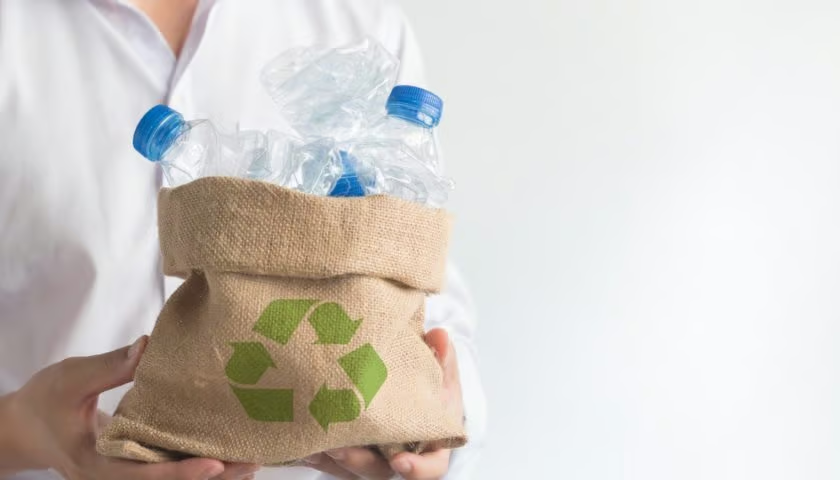
JAPAN – Japan’s Ministry of Economy, Trade and Industry (METI) announced fresh certification standards for packaging on beverage bottles, cosmetics, and household items, set to launch January 2026.
These guidelines target higher recycled content, lower plastic volumes, and easier recycling paths, extending Japan’s Design Guidelines for Plastic-Containing Products.
Companies seeking certification must provide technical evidence of compliance, opening doors to promotion under the Green Purchasing Law for public contracts.
According to METI officials, the standards prioritize beverage packaging with tailored rules for PET bottles.
Aseptic bottles require pure PET construction, excluding PVC in labels and caps, while pressure-resistant versions stay uncolored for better sorting.
Handles on dual-purpose bottles use uncolored PET, PE, or PP materials that separate readily in recycling streams.
In a statement, METI Director General Hiroshi Tanaka said, “These measures equip manufacturers with clear benchmarks to reshape packaging toward resource conservation.”
Cosmetics and household cleaners face equally precise demands. Refillable shampoo and soap containers rely on PET, PE, or PP meeting food-grade norms, with detachable caps and dispensers.
PE and PP bodies remain uncolored or white, holding densities under 0.97 grams per cubic centimeter for flotation separation, while PET stays clear.
Up to 60% recycled material applies to larger packs, and laser printing replaces traditional inks to avoid residue in recycling. A METI report notes that such designs ease consumer sorting and boost material recovery rates.
The initiative supports Japan’s circular economy goals by linking certified products to expanded recycling networks.
Public procurement preferences could accelerate adoption, as firms redesign for compliance. Industry observers expect these rules to spur investments in sorting technologies and virgin plastic alternatives.
In June, researchers from the Japan Agency for Marine-Earth Science and Technology introduced transparent paperboard from cellulose waste, fully biodegradable even at ocean depths of 757 meters.
This material, recyclable like standard paper, holds boiling water without plastic liners, offering a direct swap for single-use films in food containers.
Noriyuki Isobe, the project’s deputy chief researcher, explained that production costs would run about three times higher than conventional paper but halve carbon emissions versus plastics.
Building on this, Suntory Holdings debuted the world’s first 100% recycled aluminum Stay-on-Tab cans in September for its Premium Malt’s beers, slashing CO2 output by 60% across the supply chain.
The cans, developed with UACJ and Toyo Seikan, integrate into Suntory’s net-zero emissions target by 2050.
Deputy Division COO Masaaki Fujiwara remarked, “This collaboration cuts value-chain emissions and advances a circular society through shared recycling efforts.”
Subscribe to our email newsletters that provide busy executives like you with the latest news insights and trends from Africa and the World. SUBSCRIBE HERE


Be the first to leave a comment