
Südpack launches expansion for recyclable PharmaGuard blister packaging in Germany
The project will see the addition of new production areas dedicated to PharmaGuard.
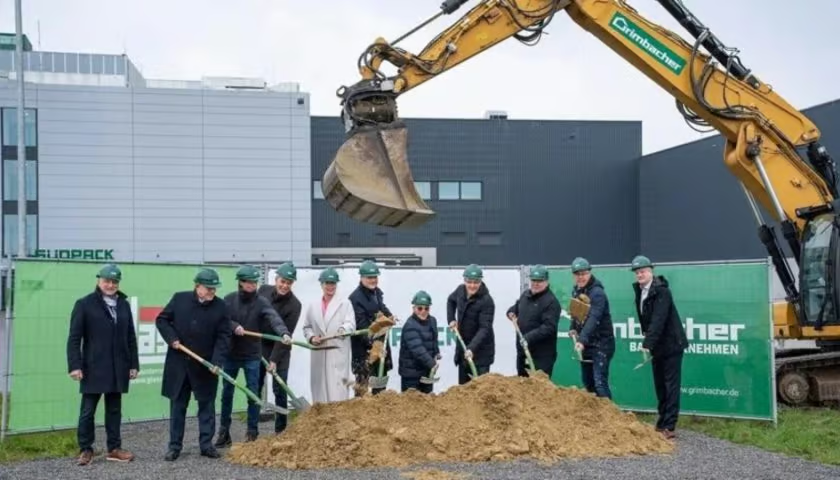
GERMANY – Packaging firm Südpack has kicked off construction at its Erolzheim facility in southern Germany to ramp up production of its PharmaGuard blister packaging.
This PP-based mono-material solution fits seamlessly into mechanical recycling systems, addressing demands for greener pharmaceutical options.
The project includes a dedicated unit for regranulating plastic waste generated during production.
According to project details, the expansion will convert an existing hall into an ISO 7-certified cleanroom compliant with GMP standards.
This space will host a new extrusion line and slitting machine. A separate building extension will accommodate supporting infrastructure, such as the regranulation setup.
Work on the site is set to wrap up by June 2026. Equipment installation will follow in the ensuing months, with full commissioning targeted for the third quarter of 2027.
Südpack established the Erolzheim location in 2020, spanning 18,800 square meters with an initial outlay of about US$43 million.
The move will generate around 50 jobs to staff the upgraded operations. Company plans outline further growth phases that could add another 120 positions by 2030.
“Our forward-looking packaging concept already meets the future sustainability requirements of the global pharmaceutical industry, as well as those outlined in the PPWR,” stated Carolin Grimbacher, managing partner at Südpack.
She noted that the recyclable mono-material cuts CO2 equivalents sharply when stacked against aluminum-PET laminates.
Grimbacher added that such steps help secure operations while advancing circular practices in plastics.
Südpack’s expansion arrives as pharmaceutical firms face tighter regulations on packaging recyclability.
The Erolzheim upgrades position the site as a hub for high-volume, eco-compliant blister output, supporting clients in Europe and beyond.
With production waste looped back on-site, the facility aims to minimize landfill contributions from the start.
Industry watchers see this as a timely response to rising calls for verifiable environmental gains in drug delivery systems
In a related push within the sector, Coveris and SABIC recently introduced a closed-loop recycling system for medical packaging.
This approach recycles hospital waste into new films containing 25% recovered material, demonstrating practical waste reduction in healthcare supply chains.
The initiative, rolled out in October 2025, processes post-consumer plastics to create barrier-protected pouches suitable for sensitive drugs.
Similarly, Olympus partnered with DuPont last October to deploy a low-carbon packaging line for medical devices.
Launched in late 2024, the system trims emissions tied to shipping and disposal, using bio-based barriers that maintain sterility without heavy reliance on fossil-derived films.
Sealed Air debuted a recycle-ready mono-material pouch for fluid foods just days ago, easing the switch from multi-layer designs.
Such innovations highlight growing adoption of single-material formats to streamline end-of-life processing.
Subscribe to our email newsletters that provide busy executives like you with the latest news insights and trends from Africa and the World. SUBSCRIBE HERE


Be the first to leave a comment