

Arridex expands 3D printing network into Ghana, targeting recycling growth
Arridex CEO Kayode Adeleke noted that African industry stops not due to insufficient ambition or talent, but because critical parts for legacy equipment are lacking, calling the initiative the launch of a borderless manufacturing network to rewrite continental manufacturing and maintenance.
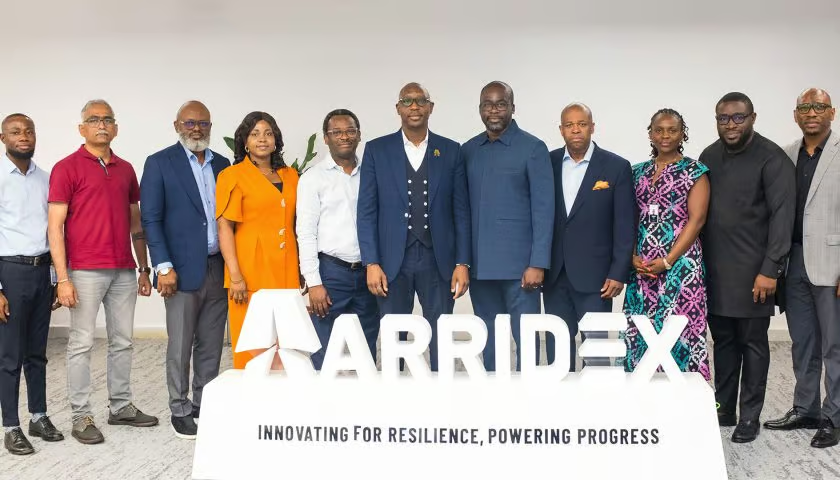
GHANA – Arridex has added a Ghana node to its Africa Distributed Additive Manufacturing Network through a partnership with Sodah Engineering and Logistics Limited, extending 3D printing capabilities while advancing recycling across West Africa.
The Nigeria-based company, previously known as RusselSmith, brings deep experience in oil and gas additive manufacturing and operates in-house metal and polymer 3D printing technologies.
It produces approved polymer parts and has collaborated with BLT on metal laser powder bed fusion and Spee3D on cold spray additive processes.
Arridex recently opened a facility known as the Omnifactory and now intends to expand its 3D printing footprint throughout the region.
Recycling Potential Embedded in Localised Manufacturing
The distributed approach carries significant implications for recycling, as local production reduces reliance on imported components while enabling recovery and reprocessing of end-of-life parts.
By manufacturing components on demand rather than stockpiling inventory, the network reduces material waste associated with obsolescence and overproduction.
Arridex has also developed a digital inventory solution allowing parts to be produced only when required, a model that supports circular economy principles by extending equipment lifespans through local repair rather than wholesale replacement.
Recycled polymer feedstocks could increasingly supply 3D printing operations as the network matures, closing material loops within African industry.
Leadership Frames Network as Borderless Manufacturing Platform
Kayode Adeleke, group chief executive of Arridex, said industry across Africa did not stop for want of ambition or talent, but frequently halted for want of a critical part in legacy equipment.
He described the initiative as the beginning of a borderless manufacturing network conceived to rewrite how manufacturing and maintenance happened across the continent.
He added that expanding into Ghana established core building blocks of a seamlessly connected, technology-driven network empowering local industries to produce high-value components on demand and build operational resilience.
Ghana Node Addresses Replacement Part Delays
Tesa D. Ayernor, managing director of Sodah Engineering, observed that when a critical part failed in Ghana, industry could wait months for a replacement to arrive from another continent, describing that wait as one of the largest undiscussed costs in the economy.
Ayernor said the network presented an opportunity for the region to leapfrog into the future, going beyond solving supply chain problems to establish true manufacturing capability.
As the first node, Ghana had the opportunity to model what was possible for every node that followed.
Subscribe to our email newsletters that provide busy executives like you with the latest news insights and trends from Africa and the World. SUBSCRIBE HERE

Be the first to leave a comment