

Syensqo to double India compounding capacity by 2028 for auto, packaging
The new compounding line will process Ryton® PPS, KetaSpire® PEEK, Amodel® PPA, and Ixef® PARA, the first asset in a modular hub designed for flexible production.
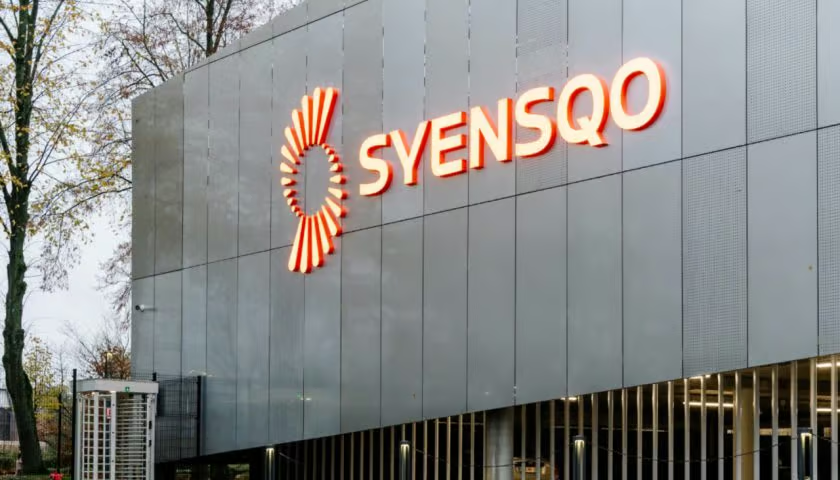
INDIA – Syensqo has announced a strategic investment to double its high-performance aromatic polymer compounding capacity at its Panoli, India facility by Q1 2028, strengthening local supply chains for the country’s rapidly expanding automotive sector and supporting circular economy goals.
The new compounding line will process a broad range of materials including Ryton® polyphenylene sulfide (PPS), KetaSpire® polyetheretherketone (PEEK), Amodel® polyphthalamide (PPA), and Ixef® polyarylamide (PARA), establishing the first asset in a modular compounding hub designed to provide production flexibility.
These high-performance polymers are widely used in demanding automotive applications, including under-the-hood components and electronic systems, where high-temperature resistance and chemical resilience are critical.
Syensqo already has manufacturing and Research & Innovation capabilities in India, and the new line reinforces its commitment to the region’s growth.
India’s Automotive Growth and Make in India Drive Localisation
Syensqo describes India as one of the world’s fastest-growing automotive markets, and the investment aligns with the Government of India’s Make in India initiative encouraging localisation of manufacturing and supply chains.
“India is an important growth market for high-performance polymers, particularly as the automotive industry continues to localize and adopt more advanced material solutions,” said Tom Wood, VP Product and Asset Manager at Syensqo.
The modular hub’s ability to switch production between different polymer families will allow Syensqo to respond more quickly and efficiently to evolving market requirements.
The project will serve both local manufacturers and international automakers and their component suppliers.
Recycling, Circular Economy and Sustainable Manufacturing Implications
The investment has significant recycling and circular economy implications for the automotive and packaging sectors.
Syensqo’s One Planet roadmap has set a target to generate 18 percent of net sales from bio-based or recycled-based products by 2030.
The company’s advanced polymer stabilisers help turn recycled resins into high-performance materials for the automotive industry, supporting the creation of a circular economy.
In 2025, 17 percent of Syensqo’s net sales were generated from bio-based or recycled-based products or products designed for durability or reuse.
The Panoli hub’s modular design supports closed-loop manufacturing, enabling efficient recovery and reprocessing of production scrap back into the compounding line.
The investment also positions Syensqo to support customers in meeting regulatory requirements for recycled content in automotive and packaging applications across the Asia-Pacific region.
This aligns with Syensqo’s wider sustainability strategy, which includes a partnership with Fairmat to recycle carbon fiber composite waste and advance material circularity.
Subscribe to our email newsletters that provide busy executives like you with the latest news insights and trends from Africa and the World. SUBSCRIBE HERE
Be the first to leave a comment