

Sade Ofset adopts Heidelberg prinect for packaging production
Sade Ofset’s Demir: cost avoidance became strategic turning point; Prinect paper stretch compensation fixed thin-material register accuracy.
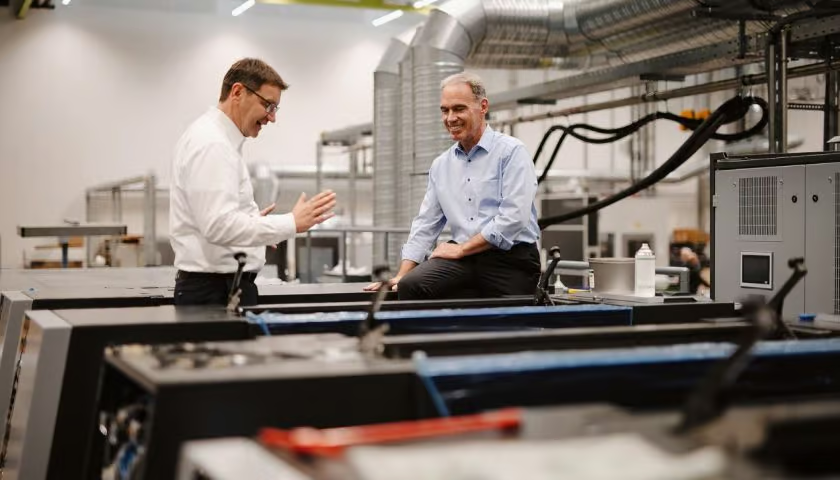
TÜRKİYE – Sade Ofset Packaging and Label has consolidated its press fleet from two machines to one after adopting Heidelberg’s Prinect Production platform, a shift that eliminated double-shift working on high-volume label and packaging work.
The company began looking for alternatives when the Raster Image Processor in its CtP system needed modernisation, a project that would have carried significant upgrade costs.
Heidelberg instead proposed a subscription arrangement granting access to the Prinect workflow, a commercial model that avoided capital expenditure at a point when Sade Ofset was running presses from other manufacturers.
Paper Stretch Compensation Solved Register Drift
Murat Demir, owner and managing partner at Sade Ofset, said the initial motivation was straightforward cost avoidance, but described the outcome as an important strategic turning point.
He identified register accuracy on thin materials as a persistent difficulty, noting that Prinect’s paper stretch compensation allowed the business to manage the problem far more effectively.
The company prints packaging and labels on substrates weighing between 70 and 80 grams per square metre, a band where dimensional movement during printing destabilises colour registration and print consistency.
Scope Extended to Planning, Costing and Monitoring
Sade Ofset subsequently widened its use of the platform beyond prepress and presswork into production planning, cost analysis and production monitoring.
That broader deployment preceded the fleet reduction. Last year the company replaced two presses with a single Speedmaster CX 104 from Heidelberg, equipped with inline colour and quality control.
The machine now absorbs volumes that previously demanded two units running double shifts.
MIS Integration Next on Automation Roadmap
The company intends to connect Prinect more closely with its existing management information system to raise automation in production control.
Jürgen Grimm, head of Prinect at Heidelberg, said the case showed that digitalisation of production processes extended well beyond individual software functions, arguing that only intelligent networking of data, machines and processes created the foundation for efficiency gains and economically successful production.
For packaging and label converters, tying workflow platforms into equipment and business systems cuts manual intervention, shortens make-ready and improves traceability across print runs.
Subscribe to our email newsletters that provide busy executives like you with the latest news insights and trends from Africa and the World. SUBSCRIBE HERE


Be the first to leave a comment