
Itochu, Daikin recycling partnership recovers 2,000T of aluminium scrap annually
Under the partnership, Itochu Metals will collect used Daikin commercial air conditioners, oversee dismantling and separation of components such as heat exchangers and motors, and coordinate with specialised scrap processors to recover high-purity aluminium, iron and copper.
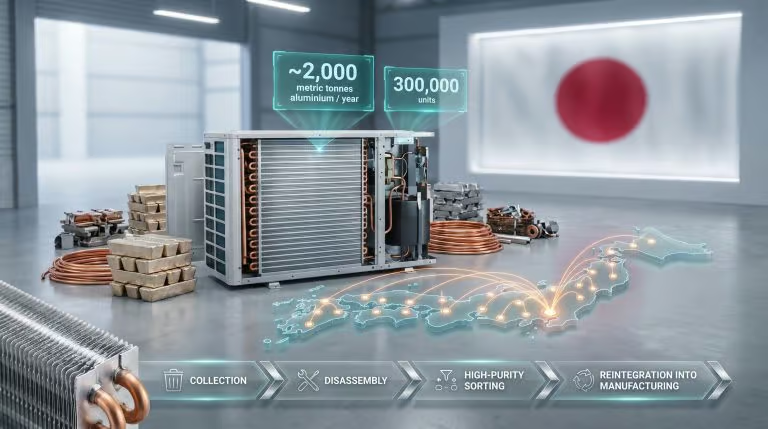
JAPAN – Itochu and Daikin have formed a joint resource recycling partnership to recover high-purity aluminium and copper from used commercial air conditioners across Japan, with 300,000 units per year yielding an estimated 2,000 tonnes of aluminium scrap.
The initiative, announced on 9 July 2026, leverages Itochu Metals’ nationwide collection network of 570 partners and 22 maintenance bases, originally established for convenience store shelving and refrigerated display cabinets, to collect used Daikin commercial units from office buildings and other commercial facilities.
Daikin estimates that a small mass-produced commercial air conditioner contains approximately 63 kg of recyclable metal scrap and plastics, including around 7 kg of aluminium and 8 kg of copper.
The partnership addresses a regulatory gap, as commercial air conditioners are not covered by Japan’s Home Appliance Recycling Law, which applies only to residential units, meaning they are generally treated as industrial waste with lower-purity metal recovery.
Detailed Sorting and Quality Management Enable Horizontal Recycling
Under the partnership, Itochu Metals will collect used Daikin commercial air conditioners, oversee dismantling and separation of components such as heat exchangers and motors, and coordinate with specialised scrap processors to recover high-purity aluminium, iron and copper.
The companies plan to consistently manage the entire resource recycling process, from collection, dismantling, sorting and refrigerant recovery through to quality evaluation, recycling and product manufacturing.
This end-to-end approach enables horizontal recycling, where recovered materials are reused in new Daikin air conditioners, rather than downcycled into lower-grade applications.
Daikin has previously demonstrated closed-loop recycling for residential air conditioner heat exchangers, achieving over 97 percent CO₂ reduction compared with primary aluminium production.
Regulatory Context and Material Recovery Scale
The Japanese government introduced targets in April 2026 requiring recycled material to account for 40 per cent of wrought aluminium used in automobiles and other manufactured products, with copper targeted at 30 per cent.
Japan imported 2.11 million tonnes of aluminium metal in 2025, of which 580,000 tonnes, 28 per cent, came from the Middle East.
With Daikin estimated to hold 40–50 per cent of Japan’s commercial air conditioner market, scaling the programme to 300,000 units annually could recover around 2,000 tonnes of aluminium scrap and 2,300 tonnes of copper scrap.
The partnership also includes expansion plans to recover plastics, electronic components and fluorocarbons as the programme develops.
Itochu plans to extend the initiative to include commercial air conditioners from other manufacturers, including those installed in convenience stores, creating a broader circular economy framework for commercial HVAC equipment across Japan.
Subscribe to our email newsletters that provide busy executives like you with the latest news insights and trends from Africa and the World. SUBSCRIBE HERE

Be the first to leave a comment