

UK consortium secures US$1.64M to develop mycelium packaging alternatives
The project highlights growing interest in bio-based alternatives to expanded polystyrene for protective packaging, provided they meet logistics operators’ performance and cost requirements.
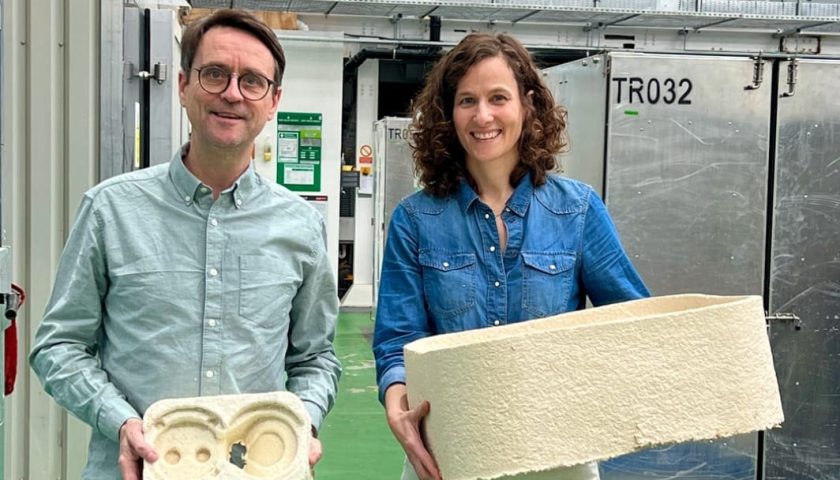
UK – The University of Nottingham has secured £1.4 million (US$1.64 million) to lead a two-year research project developing mycelium composites as non-petrochemical alternatives to expanded polystyrene in protective and transit packaging.
Funded through the Engineering and Physical Sciences Research Council Materials Innovation Partnerships programme, the venture combines academic teams from the University of Nottingham, Swansea University and the University of Bath with commercial manufacturer Magical Mushroom Company.
The project targets expanded polystyrene, which currently represents the sector benchmark for transit cushioning due to its shock attenuation and minimal mass, but which faces mounting regulatory pressure and sustainability scrutiny.
Fungal Strains and Substrates Optimised for Strength
The vegetative filament structure of fungi, mycelium functions as a natural binding agent, converting agricultural plant fibres into rigid, moulded shapes during cultivation.
The consortium will assess how fungal strains, raw substrate variations and curing conditions can be adjusted to raise strength-to-weight ratios and limit property deviations across production runs.
Consistency across batches is critical for packaging applications, where dimensional tolerances and impact performance determine whether protective formats can be adopted at commercial scale.
Fluorine-Free Surface Modifications Target Barrier Performance
To meet operational logistics demands, the academic teams are tasked with formulating fluorine-free surface modifications.
These barrier layers must counter moisture absorption, surface abrasion and fungal decay in non-climate-controlled storage without disrupting the final material’s end-of-life biodegradability.
Subsequent mechanical evaluations will document how internal cellular architectures handle shock absorption, cyclic mechanical loading and moisture exposure, providing baseline metrics to categorise which formulations suit specific packaging applications.
Commercial Trials at Beeston Manufacturing Site
Commercial trials will occur under operational conditions at Magical Mushroom Company’s manufacturing site in Beeston, Nottinghamshire.
The manufacturer, which assisted in designing the research roadmap, will oversee technical translation across all four project phases.
Magical Mushroom Company currently produces Mushroom Packaging at the Beeston plant for commercial clients including Raymarine, and maintains a technical unit that includes two MSc holders and an MEng graduate from the University of Nottingham.
Plant trials will monitor batch-to-batch variation, line speeds, defect levels, power consumption and production overheads to calculate scale-up viability for commercial packaging supply chains.
The project reflects growing interest in bio-based materials capable of replacing expanded polystyrene in protective packaging while meeting performance and cost thresholds required by logistics operators.
Subscribe to our email newsletters that provide busy executives like you with the latest news insights and trends from Africa and the World. SUBSCRIBE HERE

Be the first to leave a comment