

Bloomline Creations: Turning Textile Waste into Purpose and Hope
Wangari started thi venture to upcycle texile waste and at the same time create a sustainable business.

When Kenya banned single-use plastic bags in 2017, few imagined that the move would spark a wave of innovation that would ripple across industries and ignite fresh thinking about waste. For Wangari Kamanga, it marked the beginning of a transformative journey that would later give birth to Bloomline Creations, a small but bold enterprise breathing new life into textile waste.
“I think that was the moment I started to understand sustainability and the circular economy,” she recalls. “At the time, I was working with a manufacturing association helping communicate what the ban meant for industries and consumers. Suddenly, the country was forced to ask, if we can’t use plastic, what’s the alternative?”
The experience opened Wangari’s eyes to Kenya’s growing waste challenge, particularly in plastics. But beyond bottles and packaging, she saw another problem quietly piling up in landfills, discarded textiles. Clothes, curtains, blankets, and sheets that no longer had use at home were ending up in dumpsites, where they would take decades to break down.
“I realized that unlike organic waste, textiles don’t disintegrate. They just sit there,” she says. “That’s when I started to ask, what if we could reuse them? What if waste could become beautiful again?”
From a torn pair of jeans to a vision
Wangari’s first experiment with textile upcycling began almost by accident. One day, she found herself staring at a pair of old jeans she couldn’t bring herself to throw away. The denim was frayed and torn, yet the material was still strong. She took it to a tailor she knew, Isaac, and sketched an idea, a simple tote bag.
“There was a lot of back and forth,” she laughs. “But finally, he made it. That was my first tote bag, and I still carry it around to remind myself how it all started.”
That small act of creation lit a spark. Soon, friends, family, and church members were donating their old clothes. At first, most brought jeans, assuming the project was only about denim. But Wangari saw potential in everything, blankets, bedsheets, curtains, even carpets.
“I wanted to see how different materials could come together in one product,” she says. “Blankets became the padding, bedsheets turned into linings, and carpets gave structure. The idea was to make every part useful.”
The result was a series of colourful, one-of-a-kind bags, each piece telling a different story. Some were patched from multiple fabrics, others lined with old shirts or quilts. What could have ended up in a landfill was instead transformed into something functional and beautiful.
The birth of Bloomline Creations
At the time, Wangari was already running a communications consultancy called Bloomline Communications. When the upcycling venture began to take shape, she decided to merge her two worlds, creativity and sustainability, into one name: Bloomline Creations.
“The idea of ‘Bloomline’ came from the concept of a rose – I have been in the background for so long in many things around my career – it is now time to bloom,” she explains. “It’s about creating hope and colour out of what people consider waste.”
From its inception, Bloomline Creations was more than a passion project. Wangari saw it as a business with the potential to create jobs, raise awareness about waste management, and contribute to Kenya’s circular economy. Her vision was clear: to build an enterprise that could stand on its own, not just a social cause dependent on donations or grants.
“There’s a business in waste,” she insists. “We just have to figure out the market. If we can create products people want to buy, we can make sustainability sustainable.”
Bags with soul
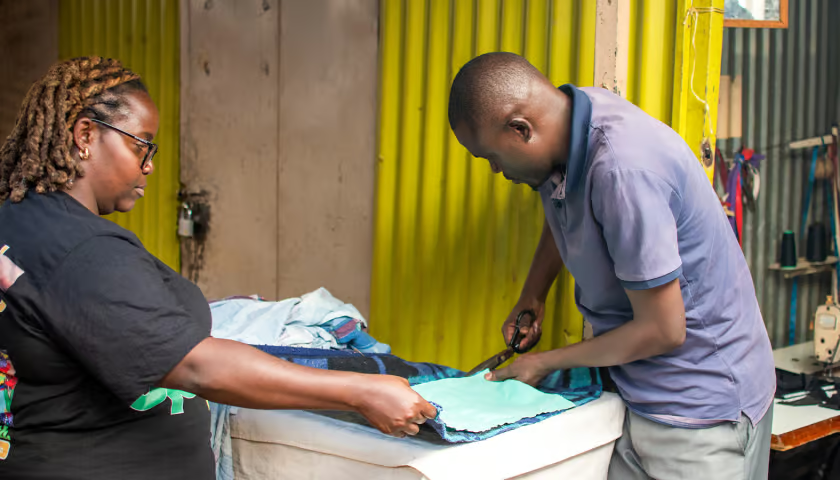
Bloomline’s signature products are tote bags, backpacks, and clutch purses, all handmade, all unique. Each carries a story, often deeply personal to the customer. Some clients bring in garments with sentimental value, a favourite T-shirt, a beloved pair of jeans, and ask Wangari to turn them into something lasting.
“One customer brought me her sister’s T-shirt,” Wangari recalls softly. “It was torn, but she couldn’t throw it away. So, we used it as the front of a bag. It became a keepsake, a way of holding onto memory.”
This personal connection gives Bloomline Creations an emotional weight that mass-produced goods can never match. Every bag is designed to be different. “No two are alike,” she says proudly. “When you buy one, you’re the only person in the world with that design.”
Her approach also challenges Kenya’s fast-fashion culture, where cheap second-hand clothes flood local markets but end up as waste within months. By transforming textile scraps into durable, high-quality products, Bloomline demonstrates that fashion can be circular, sustainable, and deeply human.
Building a circular movement
Yet, running an upcycling business in Kenya comes with its own set of hurdles. Collecting textile waste isn’t as simple as picking up bottles or cans. There’s no established take-back system in the country. And while many people have piles of old garments at home, few know what to do with them.
Most waste collectors won’t touch textiles,” Wangari explains. “They’ll take PET, glass, or metal, but not clothes. That’s why I rely on people bringing them directly to me.”
Still, she sees progress. Across Kenya, conversations about waste segregation and sustainable living are gaining traction. Bloomline has begun informal partnerships with tailors who supply fabric offcuts, and Wangari is in talks with local waste collectors to set up a more organized collection process.
She also hopes to collaborate with second-hand clothing importers to repurpose unsellable garments before they end up in dumpsites. “The goal is to catch the waste at the source,” she says. “If we can intercept it before it’s thrown away, we can make a real impact.”
The business of sustainability
As Bloomline grows, Wangari faces the classic challenge of many green entrepreneurs: balancing environmental passion with financial sustainability. Producing handmade upcycled items takes time, skill, and resources, yet the local market often undervalues such products.
“The margins are small,” she admits. “That’s why I’m looking beyond individual buyers to the export and B2B market. If we can secure consistent orders, say from boutiques, hotels, or international partners, we can scale up, hire more tailors, and handle more waste.”
Her long-term goal is to make Bloomline a continental brand, a symbol of African creativity and circular innovation. “In five years, I want us to be the go-to name for textile upcycling in Africa,” she says with conviction. “A business case that shows recycling isn’t just good for the planet—it’s good for business too.”
A bag of hope
Among Bloomline’s most touching initiatives is the Bag of Hope project. For every two bags sold, Wangari commits to making an extra one for donation to a child in need. Many schoolchildren in rural Kenya still carry books in plastic or paper bags. Bloomline’s handmade school bags provide a small but meaningful alternative.
“It’s not charity, it’s purpose,” she says. “I want it to be our corporate social responsibility, not a dependency model. If a child can walk to school with dignity carrying a bag made from what others threw away, that’s powerful.”
Challenges and the road ahead
Even as she dreams big, Wangari is candid about the obstacles ahead. Collecting enough clean textile waste remains difficult, as many people hesitate to part with old clothes due to sentimental attachment. Machinery is another constraint, thicker materials like carpets and blankets can break sewing needles, slowing production.
Then there’s the matter of awareness. “Many people still don’t understand what circular economy means,” she says. “They think recycling is just about bottles. But it’s also about rethinking how we use what we already have.”
To address this, she seesk to use her background in communications to educate customers and communities through storytelling. ‘ I am in the process of working with other story tellers to use ou social media to share transformation stories—before-and-after photos of fabrics reborn as new products. Each post becomes a small act of environmental education.
Policy and partnership
Kenya’s waste management landscape is evolving, with new laws like the Sustainable Waste Management Act and EPR regulations aiming to promote circular practices. Wangari hopes that future policies will extend to textiles, offering incentives for small upcyclers like her to set up local workshops.
“Waste management is now devolved,” she notes. “So, if counties could partner with enterprises like Bloomline to process textile waste locally, it would create jobs and reduce landfill pressure. Incentives like tax breaks or access to workspace would go a long way.”
Her advocacy extends beyond her own business. She dreams of building a network of African upcyclers, a community of changemakers transforming waste into opportunity. “We can’t do it alone,” she says. “There’s enough waste for everyone. The more of us doing this, the better for the planet.”
A story of purpose
Today, Bloomline Creations is still a small operation. Wangari works closely with one main tailor, sometimes hiring others for big orders. Every bag that leaves her hands carries the imprint of collaboration, patience, and purpose. It’s a modest beginning, but one grounded in vision.
When asked what keeps her going, she pauses for a moment before replying: “Hope. The belief that we can change how people see waste. That something torn, forgotten, or discarded can become useful again.”
From a single pair of jeans to a growing movement, Wangari ‘Rosy’ Kamanga’s story is a testament to what happens when creativity meets conscience. In her hands, scraps of fabric become not just bags, but symbols of resilience, renewal, and the promise of a greener Kenya.
Subscribe to our email newsletters that provide busy executives like you with the latest news insights and trends from Africa and the World. SUBSCRIBE HERE


Be the first to leave a comment