
Nestlé Nigeria achieves 100% plastic neutrality through industry-led recycling alliance
This milestone reflects a shift from company-level action to industry-wide collaboration.
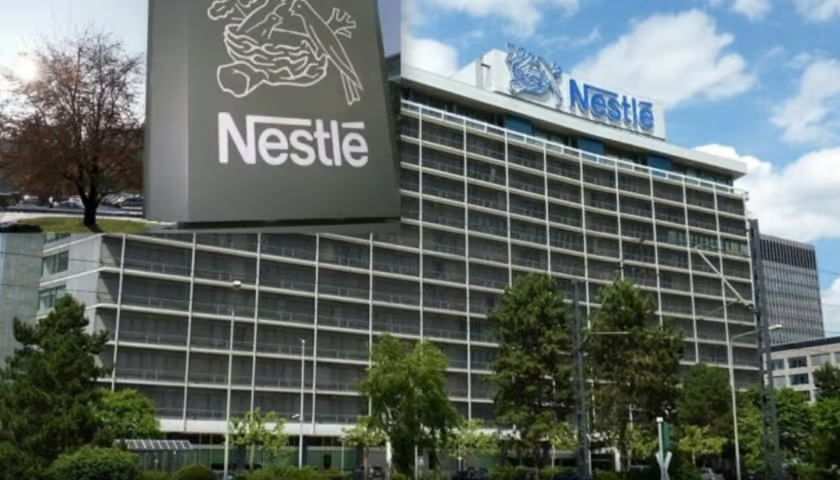
NIGERIA – Nestlé Nigeria has announced that it has achieved 100% plastic neutrality, confirming that it is now taking back and recovering the equivalent of every tonne of plastic it introduces into the Nigerian market.
The milestone has been delivered through the Food and Beverage Recycling Alliance (FBRA), Nigeria’s first Producer Responsibility Organization (PRO), established in 2018 under the country’s Extended Producer Responsibility (EPR) policy.
FBRA has expanded significantly since its launch, growing from four founding members to 49 member organizations as of November 2025, collectively working to recover, recycle and reintegrate post-consumer packaging waste into the economy.
Nestlé Nigeria said the achievement reflects a shift from company-level action to industry-wide collaboration.
“Our approach goes beyond profit and emphasizes stewardship of the planet,” said Victoria Uwadoka, Corporate Communications, Public Affairs and Sustainability Lead at Nestlé Nigeria.
“While companies may compete commercially, we collaborate on shared environmental responsibilities to deliver sustainable impact.”
Plastic neutrality means that Nestlé Nigeria supports the collection and recycling of an amount of plastic equivalent to what it places on the market, ensuring that packaging does not end up in landfills, waterways or the ocean.
Under the FBRA framework, plastic waste is aggregated, recycled and reintegrated into production cycles, creating both environmental and economic value.
Nestlé has also been at the forefront of recycled-content packaging in Nigeria. The company pioneered the use of 50% recycled polyethylene terephthalate (rPET) in its Nestlé Pure Life bottled water, fully compliant with food-grade packaging standards.
According to the company, some of the plastics recovered through FBRA are now being channelled back into this rPET packaging initiative, closing the loop within the local market.
“Every bottle that is taken out and doesn’t end up in the ocean is one bottle less of a problem,” Uwadoka said.
“Closing the loop is key. Circularity is the destination. It’s not just about collection, but ensuring we use, collect, transform and reuse.”
Since 2018, FBRA and Nestlé Nigeria have collectively recovered more than 100,000 metric tonnes of plastic waste.
The program has supported community clean-up efforts, created income opportunities for waste collectors and strengthened Nigeria’s emerging circular economy infrastructure.
The achievement comes amid growing regulatory and investor pressure on consumer goods companies operating in Africa to demonstrate tangible progress on plastic waste and circularity.
Nigeria, Africa’s largest consumer market, has been accelerating discussions around EPR enforcement, recycled content targets and private-sector-led waste recovery models.
Industry observers say Nestlé Nigeria’s plastic neutrality milestone sets a benchmark for fast-moving consumer goods companies operating in the country.
By combining EPR-driven collaboration, recycled-content packaging and local recycling capacity, the initiative illustrates how multinational brands can align global sustainability commitments with on-the-ground impact in emerging markets.


Be the first to leave a comment