

Alliance Report: 30% recycled film content possible from household plastic waste with advanced mechanical recycling
The study also found that chemical recycling will be complementary to advanced mechanical recycling, with each targeting different fractions of the flexible waste stream and different end-uses, particularly multi-material films for food-contact applications.
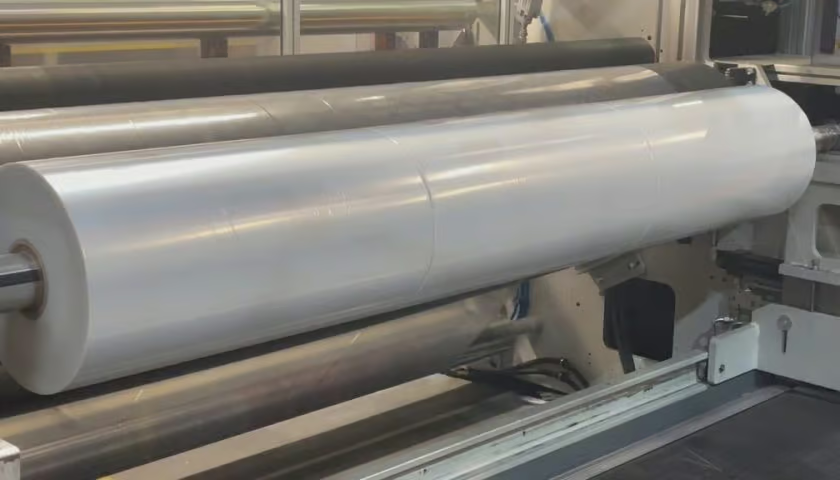
GLOBAL – The Alliance to End Plastic Waste has released a report demonstrating that post-consumer household flexible plastic waste can be processed into recyclates suitable for over 30% recycled content in shrink films, labels and pouches using existing sensor-based sorting, hot-washing and double-melt filtration systems.
The study, titled ‘The Quest for Quality: Scaling Advanced Mechanical Recycling to Meet Recycled Content Targets for Flexibles’, examines a 50,000-tonne-per-annum advanced mechanical recycling facility for flexible plastics.
The report provides a comprehensive technical and economic assessment of such a plant and identifies the conditions needed to scale these solutions commercially.
It comes at a critical moment as brands, retailers and packaging producers prepare for the EU’s Packaging and Packaging Waste Regulation, which mandates 35% post-consumer recycled content in non-food packaging by 2030.
How Sensor-Based Sorting, Hot-Washing and Double-Melt Filtration Enable 30%+ Recycled Content
The report’s key finding shows that household flexible plastic waste can be transformed into high-quality recyclates for demanding film applications using commercially available technologies.
Advanced mechanical recycling can deliver this quality by deprioritising traditional low-cost, mixed commodity processing and adopting a ‘market-pull’ approach focused on producing premium recyclates that meet converter and brand requirements.
The study also found that chemical recycling will be complementary to advanced mechanical recycling, with each targeting different fractions of the flexible waste stream and different end-uses, particularly multi-material films for food-contact applications.
The report builds on key learnings from the ValueFlex project, launched in 2022 by the Alliance, CEFLEX, Roland Berger and HTP Engineering to develop a commercially viable 50,000-tonne-per-annum advanced mechanical recycling solution.
What Systemic Enablers and Capital Optimisation Mean for Flexible Packaging Recycling
To bridge the economic gap between high-quality recycling and virgin polymers, the report identifies critical enablers including robust Extended Producer Responsibility schemes to fund collection and sorting, mandated recycled content targets to drive demand, and access to concessionary capital.
On capital expenditure, the study highlights that greenfield civil works account for 31% of CapEx while complex sorting equipment represents 25%.
To improve project viability, operators should consider upgrades at existing brownfield sites and shift more sorting activity upstream to centralised Plastics Recovery Facilities.
Alliance to End Plastic Waste president and CEO Jacob Duer stated that flexible plastic packaging is one of the most challenging packaging formats to recycle at scale, but also one of the most important to get right, with the technology to produce high-quality recyclates already existing and the challenge now being scaling these solutions commercially through stronger alignment across the value chain.
Subscribe to our email newsletters that provide busy executives like you with the latest news insights and trends from Africa and the World. SUBSCRIBE HERE

Be the first to leave a comment