

Belgium’s digital watermark pilot diverts snack wrappers into food-grade recycling loop
Packaging from participating brands, including Mondelez, Ferrero and PepsiCo, is being placed on Belgian shelves.
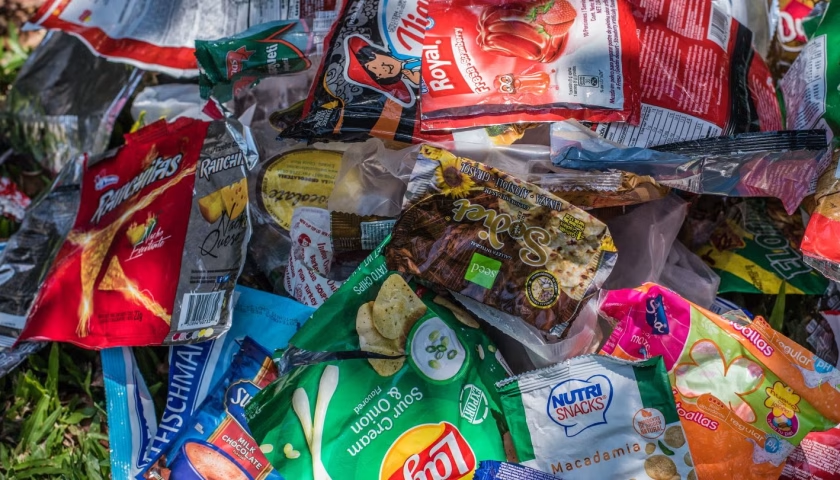
BELGIUM – Fost Plus has launched a Belgian pilot using invisible watermarks on snack wrappers to enable sorting and recycling of flexible food packaging into new food-grade materials.
The scheme, coordinated by non-profit organisation Fost Plus in collaboration with Digimarc, represents the first large-scale test of its kind in Europe.
The technology places an imperceptible watermark, comparable to a QR code, directly on plastic packaging.
At sorting facilities handling material from Belgium’s nationwide PMD system, high-resolution cameras detect these watermarks and separate food-contact packaging from non-food items.
This separation is critical because recycled plastic intended for food packaging must meet stringent safety requirements.
Currently, while polypropylene and polyethylene films are collected and recycled, it is not possible to differentiate between packaging that contained food and that used for non-food products, limiting circular applications.
How Invisible Watermarks and German Sorting Infrastructure Enable Closed-Loop PP Recycling
The pilot addresses a key challenge posed by the PPWR: by 2030, all plastic food packaging must contain at least 10 percent recycled material.
For PET, this is already achievable, but for flexible polyolefin packaging, no food-grade recyclate is currently available at scale.
The digital watermarking approach aims to change that.
Packaging from participating brands, including Mondelez, Ferrero and PepsiCo, is being placed on Belgian shelves.
After consumer use and disposal in the blue PMD bag, the flexible PP stream is sent to a specialised sorting centre in Hündgen, Germany, where watermarks enable accurate sorting of food-grade material for recycling trials.
What the PPWR 10% Recycled Content Mandate Means for Flexible Packaging and EPR Compliance
The pilot provides valuable data on consumer sorting behaviour and packaging design.
The pilot, part of the HolyGrail 2030 initiative, is designed to prove the business case for broad market adoption of digital watermarking for flexible packaging.
Under Belgium’s Extended Producer Responsibility rules, companies marketing more than 300 tonnes of packaging or 100 tonnes of packaged products must report their packaging data annually, reinforcing the importance of accurate material accounting.
If the trial works, the approach may support Belgium in meeting upcoming European requirements on recycled content in food packaging and in supporting the domestic recycling industry.
The pilot involves large food groups including Mondelez, Ferrero and PepsiCo, with the technology enabling sorting equipment to recognise food-related packaging and keep it apart from other plastic refuse.
Subscribe to our email newsletters that provide busy executives like you with the latest news insights and trends from Africa and the World. SUBSCRIBE HERE

Be the first to leave a comment