

India’s 850KT recycling commitments triple target, paving way for global critical minerals hub
The recycling incentive scheme covers 27 critical minerals and links incentives to actual mineral recovery and processing rather than merely producing intermediate materials.
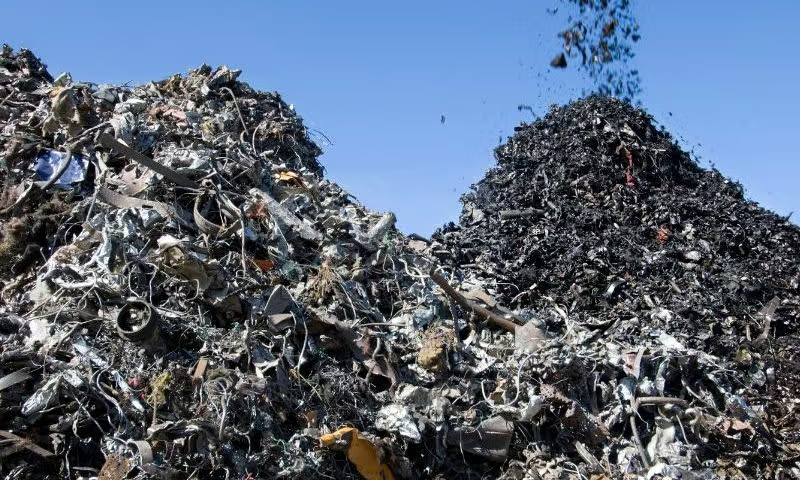
INDIA – India’s Ministry of Mines has received industry commitments for 850 kilotonnes of critical minerals recycling capacity against an initial 270 kilotonne target, signaling strong private sector participation in a sector crucial for electric vehicles, electronics and renewable energy.
The announcement was made by Union Mines Secretary Piyush Goyal at a conference on India’s critical minerals recycling landscape organised by the Materials Recycling Association of India.
Critical minerals including lithium, cobalt, nickel, graphite, rare earth elements, zirconium and titanium are essential for batteries, EVs, solar panels, wind turbines, semiconductors, defence equipment and digital technologies.
Against the target of 270 kilotonnes, Goyal said the government had received commitments of 850 kilotonnes, giving confidence that India could emerge as a major hub for critical mineral recycling not only in Asia but globally by the next decade.
How Four Critical Minerals Processing Parks in Maharashtra, Gujarat, Odisha and Andhra Pradesh Support Recycling
The Mines Ministry announced support for establishing four Critical Minerals Processing Parks in Maharashtra, Gujarat, Odisha and Andhra Pradesh, with recycling forming an integral component of these proposed facilities.
For Maharashtra, which hosts major automobile manufacturing clusters, electronics industries and one of the country’s largest concentrations of urban e-waste generation, the proposed infrastructure could enhance its position in emerging battery and clean technology value chains.
The recycling incentive scheme covers 27 critical minerals and links incentives to actual mineral recovery and processing rather than merely producing intermediate materials.
Why 571 Exploration Projects and 212 Mineral Blocks Drive India’s Critical Minerals Mission
The Geological Survey of India has already completed 571 exploration projects, with another 300 projects expected to be completed this year.
Against the original target of 1,200 exploration projects by 2031, the government now expects the figure to exceed 2,000 projects, aided by increasing private sector participation.
The government auctioned a record 212 mineral blocks last year, while 36 mines, including 28 greenfield projects, were operationalised during 2025-26.
Goyal stated that the government was close to finalising a dedicated scheme to build processing capabilities for battery minerals after multiple rounds of stakeholder consultations.
MRAI president Sanjay Mehta noted that India’s status as the world’s third-largest automobile market, its rapidly expanding battery manufacturing sector and growing electronics industry made recycling a strategic necessity, adding that mining alone cannot meet future demand and that urban mines are becoming as important as natural mines.
Subscribe to our email newsletters that provide busy executives like you with the latest news insights and trends from Africa and the World. SUBSCRIBE HERE

Be the first to leave a comment