
L’Oréal invests US$4.5M in Cairo factory to expand capacity, leverage local packaging
Aiming to boost local sourcing, the expansion sees L’Oréal join other Egyptian FMCG firms procuring raw materials and packaging domestically.
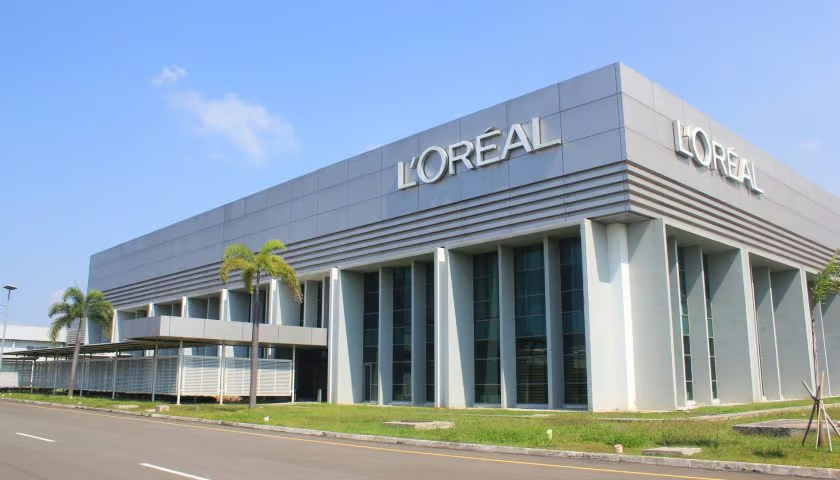
EGYPT – L’Oréal has committed EGP240 million (US$4.5 million) in 2026 to expand its Cairo manufacturing facility, funding new production lines for haircare, hair colouration and skincare while increasing locally sourced packaging materials.
The expansion aims to raise the proportion of locally sourced materials, with L’Oréal joining other FMCG manufacturers in Egypt seeking to procure raw materials and packaging from domestic suppliers.
This shift reduces reliance on imported inputs, which have become costlier and less predictable amid currency volatility.
For packaging converters, the strategy creates opportunities to supply bottles, caps, labels and cartons meeting multinational quality standards, while shortening lead times and lowering freight exposure for the Cairo operation.
Cairo Facility Anchors MENA Consumer Products Supply
L’Oréal’s Egyptian factory currently exports 85 percent of its output to over 20 countries across the Middle East and North Africa.
Established in 2013 on a 100,000-square-metre plot with a 17,000-square-metre built facility in 10th of Ramadan City, it operates as the primary MENA hub for the Consumer Products Division, serving brands including L’Oréal Paris and Garnier.
The site sits alongside L’Oréal’s two other Africa and Middle East manufacturing bases in Midrand, Johannesburg, which produces ethnic haircare and beauty brands including Dark and Lovely and Mizani, and Nairobi, which serves East Africa with the Nice & Lovely brand.
Multinationals Expand Egyptian Packaging Capacity
L’Oréal is among several multinational personal care companies investing in Egypt. In July 2026, Procter & Gamble confirmed ongoing capacity expansion at its Egyptian factories to increase export volumes to African and Gulf markets.
Unilever is expanding its personal care factory capacity in Egypt to 150,000 tonnes annually and preparing to launch a new haircare production line.
Hayat Kimya opened a US$60 million tissue factory in May 2025 and invested an additional US$52 million in a health products plant operational in 2026.
Abdos FMCG inaugurated the first phase of a US$30 million cosmetics manufacturing facility in February 2025.
Currency Weakness and Regional Access Reinforce Egypt’s Position
The continued weakness of the Egyptian pound has made domestic manufacturing more critical for companies targeting the mass market, while making Egyptian-made products comparatively cheaper for export.
Significant investment has spanned FMCG categories, including PepsiCo’s cumulative US$515 million capital expenditure over five years, Mars completing a US$280 million confectionery expansion in 6th of October City, and Coca-Cola Hellenic Bottling Company announcing a US$1.28 billion plan spanning 2026 to 2030.
The prospect of supply chain disruptions in Saudi Arabia, the UAE, Kuwait, Bahrain and Qatar reinforces Egypt’s position as a regional supply option, given its access to the port of Jeddah and overland routes into the wider GCC.
Subscribe to our email newsletters that provide busy executives like you with the latest news insights and trends from Africa and the World. SUBSCRIBE HERE
Be the first to leave a comment