
July 2026: Mandates, Mergers and Millions Reshape MEA Packaging, The Month Sustainability Got Real
Across the Middle East and Africa, the packaging industry moved from ambition to action with a velocity that caught even seasoned observers off guard, policy mandates went live, billion-dollar deals reshaped the competitive landscape, and recycling infrastructure stopped being a talking point and started becoming a revenue stream.
If June was about promises, July was about delivery. The region’s packaging sector hit an inflection point where regulatory pressure, investment discipline, and consumer expectation converged into something tangible.
The headlines weren’t about future goals, they were about current reality.
When Governments Got Serious
The month kicked off with a regulatory cascade that would have seemed unthinkable just a few years ago.
India mandated rising recycled content for rigid plastic packaging under its EPR framework, targeting 60% by 2028-29, a signal that Asia’s third-largest economy is serious about closing the loop.
Nigeria’s NESREA defended a phased 25% rPET mandate, positioning it as a necessary step for a circular economy.
In the GCC, Oman mandated palletisation for all import shipments with a phased rollout from July 15 to September 15. The message was unmistakable: packaging standards in the region are no longer optional.
But the real regulatory earthquake came from Europe.
The European Court of Justice rejected the legality of the “mass balance” accounting method for chemically recycled plastics, sending shockwaves through the global packaging industry. Meanwhile, the European Commission initiated infringement proceedings against 14 EU member states for missing packaging recycling targets, including Germany.
For MEA exporters, the message was clear: PPWR compliance is no longer optional.
The Billion-Dollar Shuffle
July was a playground for M&A activity. Saica Group’s acquisition of Thimm Group’s corrugated packaging plants across Germany, Poland, the Czech Republic, and Romania added 1,200 million square metres of production capacity. Saica’s 2025 sales stood at €3.961 billion (US$4.4 billion), while Thimm generated approximately €539 million (US$602 million) in 2024. The deal added 2,500 employees to Saica’s workforce of 12,000.
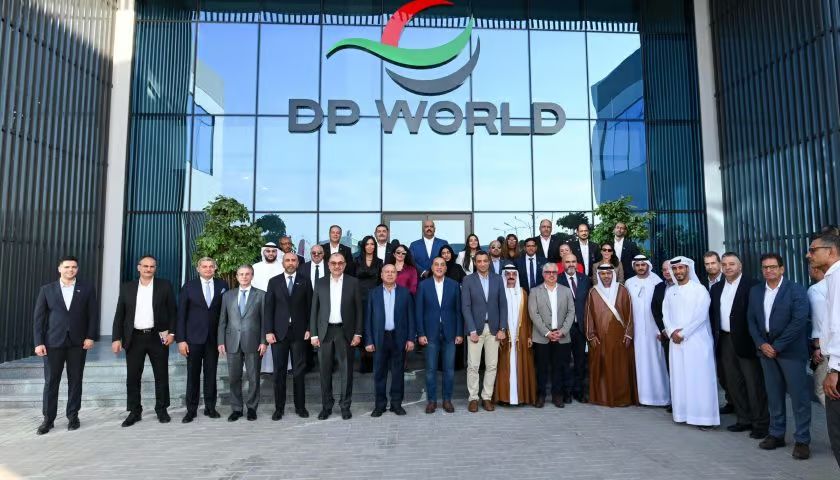
In the MEA heartland, DP World launched Egypt’s first integrated logistics and packaging centre at Sokhna, adding repackaging, labelling and customization services to its offering. The Dubai-based group has invested more than US$1.4 billion in Egyptian logistics infrastructure, including Sokhna Port expansion and a cold chain facility currently under construction.
Gerresheimer opened a new US$75 million pharmaceutical glass packaging plant in China, doubling its injectable drug packaging capacity and creating approximately 300 jobs. The investment reflects a broader trend: as the MEA region’s pharmaceutical sector expands, glass is staging a comeback.
Heidelberg announced its full acquisition of POLAR, strengthening its post-press automation offering for packaging and label production. The move gives Heidelberg control over the entire production chain, from printing to cutting, die-cutting to banding. CEO Jürgen
Otto stated that the integration strengthens Heidelberg’s position in the printing and packaging industry by expanding its value chain.
In Iberia, Lappí Labels and Flexible Packaging acquired Portuguese flexible packaging provider Alempack, with combined sales expected to exceed €70 million (US$79.7 million). The deal expands Lappí’s workforce from 350 to over 390 employees and increases its production facilities from 51,000m² to around 60,000m².
Africa Gets Its Manufacturing Mojo
ACS Holding‘s subsidiary SACAR exported over 80,000 corrugated cardboard units to Mauritania, marking GIPEC Group’s return to international markets after an eight-year hiatus. The move is a powerful indicator of Algeria’s non-hydrocarbon export strategy gaining traction.
In Ghana, the Ghana Publishing Company acquired a rare six-colour Xerox Iridesse digital press, positioning itself to compete in the premium commercial printing market with a capability only three other machines in the country could match.
Managing Director Nana Kwasi Boatey’s assessment was blunt: “If you want the best quality press, the best place to go will be the Ghana Publishing Company.” The confidence was backed by numbers: profit after tax rose from GH¢2.23 million (US$142,000) in 2024 to GH¢16.96 million (US$1.08 million) in 2025, and revenue climbed from GH¢60.78 million (US$3.87 million) to GH¢72.85 million (US$4.64 million).

Africa Gets Its Manufacturing Mojo
ACS Holding‘s subsidiary SACAR exported over 80,000 corrugated cardboard units to Mauritania, marking GIPEC Group’s return to international markets after an eight-year hiatus. The move is a powerful indicator of Algeria’s non-hydrocarbon export strategy gaining traction.
In Ghana, the Ghana Publishing Company acquired a rare six-colour Xerox Iridesse digital press, positioning itself to compete in the premium commercial printing market with a capability only three other machines in the country could match.
Managing Director Nana Kwasi Boatey’s assessment was blunt: “If you want the best quality press, the best place to go will be the Ghana Publishing Company.” The confidence was backed by numbers: profit after tax rose from GH¢2.23 million (US$142,000) in 2024 to GH¢16.96 million (US$1.08 million) in 2025, and revenue climbed from GH¢60.78 million (US$3.87 million) to GH¢72.85 million (US$4.64 million).
The Recycling Revolution Finally Arrives
Oman achieved a total recycling rate of approximately 39 percent, recycling about 1.37 million tonnes of waste through 96 facilities, with 26 dedicated plastic recycling factories.
The sultanate’s plastic recycling sector has emerged as one of the fastest-growing industries, driven by Environment Authority Decision No 8/2024, which prohibits single-use plastic shopping bags across all commercial establishments.
Jordan ramped up its e-waste recycling infrastructure with eight specialized factories and 34 collection centers nationwide, while launching the country’s first “recycling bank” facility on a 3,000-square-meter plot in Amman.
A joint study with the German Jordanian University is developing a lifecycle tracking system for electric vehicle batteries.
Tanzania’s National Commission for Science and Technology launched a Black Soldier Fly larvae pilot project in Babati that reduces organic waste volume by up to 70 percent while producing high-protein animal feed and fertiliser.
The patented technology, developed by researchers from the Dar es Salaam University College of Education and the University of Dar es Salaam, has been officially recognised for its contribution to advancing science and sustainable development.
In South Africa, Kwality Holdings partnered with Waste2Wear to introduce blockchain-verified recycled products, with each item featuring a QR code that enables traceability from waste source to finished item. Waste2Wear’s solutions demonstrate reductions of up to 88 percent in energy consumption, 71 percent in carbon emissions, and 46 percent in water usage compared to conventional virgin-material production.
Nigeria saw significant recycling infrastructure development as the Abuja Environmental Protection Board partnered with UNIDO to train waste workers on plastic waste handling, segregation, and safe recycling practices, strengthening the capacity of the Waste Pickers Association of Nigeria.
The project, funded by the Government of Japan since 2022, has established a waste collection centre in Jabi.
The Final Word
The packaging industry in July 2026 demonstrated that it is moving beyond pilot projects and aspirational goals. It is entering a phase of concrete action, regulatory enforcement, and industrial-scale investment. Sustainability is no longer a niche market; it is the central driver of innovation, competition, and growth.
The future of packaging in the MEA region is not about doing less, it is about improving thoughtfully, consistently, and step by step. And July 2026 was the month that proved the industry is ready.
Subscribe to our email newsletters that provide busy executives like you with the latest news insights and trends from Africa and the World. SUBSCRIBE HERE
Be the first to leave a comment