

Cairo University’s 26.8% PVC bacterial degradation breakthrough for bioremediation, recycling
The Egyptian bacterial consortium provides a scalable biological pathway for tackling one of the most problematic plastics in the recycling stream, offering a nature-based alternative to energy-intensive chemical recycling processes.
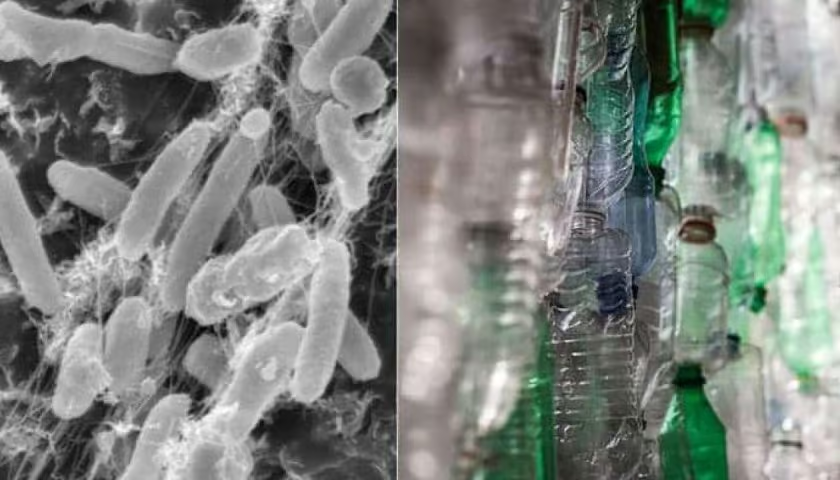
EGYPT – Cairo University researchers have discovered that the bacterial strain Stutzerimonas sp. NH2, isolated from contaminated soil, degrades approximately 23.4 percent of polyvinyl chloride plastic mass, with degradation increasing to 26.8 percent when combined with Glutamicibacter nicotinae NH27.
The study, published in the Q1-ranked journal Microbial Cell Factories by Springer Nature, confirms through scanning electron microscopy and chemical analysis that cracks and voids appear in the PVC structure under bacterial action.
The research team, supervised by Professor Tarek Abdelmawgoud Abdelmuttalib Morsi and including Dr. Nawal Magdy, Mahmoud Sabry Maher, Ahmed Mohamed Soliman and Dr. Hoda Shehata, conducted the study entirely at Cairo University’s Faculty of Science laboratories.
How Bacterial Consortia Achieve 26.8% PVC Degradation Through Synergistic Action
The study isolated Stutzerimonas sp. NH2 (95% similar to Stutzerimonas stutzeri) and Glutamicibacter nicotinae NH27 (99.64% similar to Glutamicibacter nicotianae) from long-term plastic-contaminated soil.
While strain NH27 alone achieved only 5.87 percent degradation efficiency, the equal-volume consortium of both strains delivered significantly higher performance at 26.84 percent weight loss.
The bacterial growth peaked at day 20, with the consortium reaching optical density of 0.35 compared to 0.30 for NH2 alone, while pH dropped from 6.9 to 5.56 in the consortium treatment.
Fourier-transform infrared spectroscopy revealed reduced functional group intensities, thermogravimetric analysis showed measurable thermal stability decline, and gas chromatography-mass spectrometry detected degradation products confirming chemical structural modifications.
Dean Sohair Ramadan Fahmy of the Faculty of Science at Cairo University noted that the publication of this Egyptian-led research in a leading international journal demonstrated the ability of Egyptian scientists to develop innovative biotechnological solutions to current global environmental challenges.
Why PVC Biodegradation Addresses a Critical Recycling Gap
Polyvinyl chloride production exceeds 40 million tonnes annually, with most ending in landfills or incinerators due to its chlorine content, which makes it difficult to recycle mechanically and releases toxic hydrogen chloride gas when heated above 150°C.
The Cairo University discovery, described as “100 percent Egyptian research” by Dean Fahmy, represents the highest reported PVC degradation rate to date.
Similar efforts include UAE research where Bacillus subtilis achieved up to 16.95 percent PVC degradation in saline soils, and Russian research using titanium phosphate stabilizers to raise PVC decomposition temperature.
The Egyptian bacterial consortium provides a scalable biological pathway for tackling one of the most problematic plastics in the recycling stream, offering a nature-based alternative to energy-intensive chemical recycling processes.
Subscribe to our email newsletters that provide busy executives like you with the latest news insights and trends from Africa and the World. SUBSCRIBE HERE
Be the first to leave a comment