
NASENI unveils plan for Nigeria’s first metal additive manufacturing hub
Powder recovery and recycling lets unused and residual metal powders be reprocessed, lowering waste and input costs and supporting circular flows on-site.
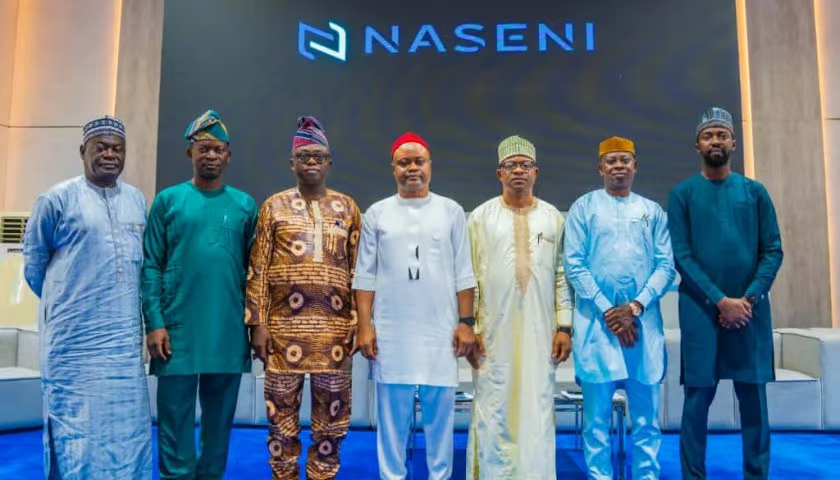
NIGERIA – Nigeria’s National Agency for Science and Engineering Infrastructure has announced plans to build the country’s first Metal Additive Manufacturing Hub, aiming to reduce reliance on imported industrial components while advancing metal recycling and domestic 3D printing capacity.
The proposal was outlined in a paper presented by Abdulrahman Barkindo Bawuro, overseeing officer of the Advanced Manufacturing Technology Development Institute, a NASENI division based in Jalingo, Taraba State.
The paper was delivered on Bawuro’s behalf by Chief Engineer Okechukwu Chijioke during the second edition of the agency’s Science Perspective Engagement Series at NASENI headquarters in Abuja.
Powder Recovery and Recycling Anchor Facility Design
As described, the envisioned hub would integrate the full metal additive manufacturing ecosystem under one roof, including digital product design, process simulation, laser powder-fusion systems, powder recovery and recycling, surface finishing and quality assurance facilities.
The powder recovery and recycling component would allow unused and residual metal powders to be reprocessed, reducing waste and input costs while supporting circular material flows within the facility.
Bawuro proposed a public-private partnership structure to fund and operate the hub, with government supplying enabling infrastructure while private companies contribute specialised equipment, technical expertise and investment capital.
Recycling Extends to Minerals Sector Linkage
Bawuro framed metal additive manufacturing, which builds components layer by layer from digital designs rather than removing material from larger stock, as a route to greater precision, less waste and the ability to produce complex, customised parts.
He pointed to global applications including aircraft parts, medical implants, turbine systems, electric vehicle components and oilfield equipment.
He tied the proposal directly to Nigeria’s solid minerals sector, arguing that locally processed minerals could serve as feedstock for metal powders used in additive manufacturing, adding value domestically rather than exporting raw materials.
Agency Frames Event as Innovation Platform
Hassan Bakare, deputy director and head of research and laboratory development, described the series as a platform for knowledge exchange and practical problem-solving on Nigeria’s technological and industrial challenges.
Closing the session, NanoBio deputy director Oladipo Dele Kayode called on participants to turn discussion into concrete innovations advancing national industrial development.
No timeline, funding figure or specific site for the proposed hub was disclosed.
Subscribe to our email newsletters that provide busy executives like you with the latest news insights and trends from Africa and the World. SUBSCRIBE HERE

Be the first to leave a comment