

AkzoNobel launches Securshield 810 heat-seal lacquer for food cans
The lacquer has a 22% lower carbon footprint per square metre than epoxy alternatives, potentially reducing packaging-related emissions.
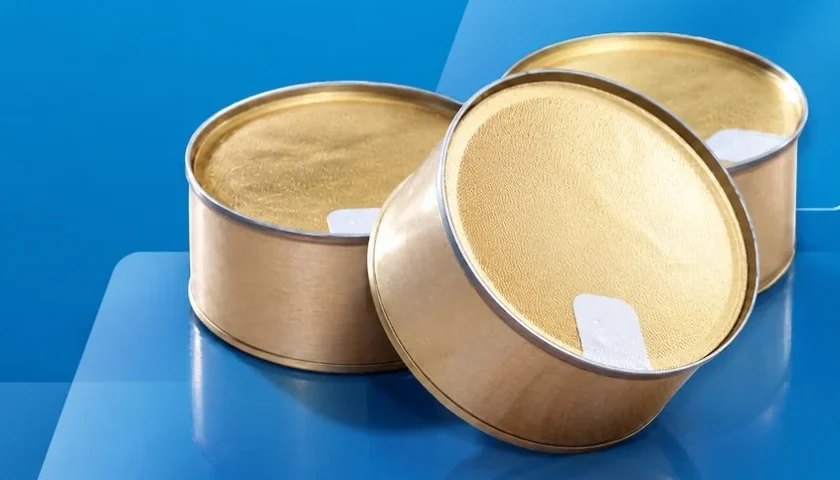
EMEA – AkzoNobel Packaging Coatings has rolled out Securshield 810, a gold heat-seal lacquer for can rings fitted with easy-peel foil openings on food cans, designed as a replacement for epoxy coatings to maintain sealing performance and production-line efficiency.
Securshield 810 is BPA non-intent and PFAS non-intent, adding to AkzoNobel’s non-intent range for food and beverage packaging. The product is intended for steel and aluminium ring applications.
For cans containing low-aggressive food types, the lacquer can be used in a single-coat system.
Cans used for medium- and high-aggressive fillings require Securshield 510 size coat alongside Securshield 810, a combination providing a BPA non-intent and PFAS non-intent coating system for different food-can applications.
The distinction matters because aggressive fillings can attack coating layers, requiring an additional barrier to prevent corrosion and metal migration into food.
Lower Carbon Footprint Than Epoxy Alternatives
The lacquer is available in Europe, the Middle East and Africa in gold, offering heat-sealing properties, stamping performance and the flexibility needed to curl the foil membrane.
Its higher solids content results in lower volatile organic compound emissions.
The lacquer has a 22 percent lower applied carbon footprint per square metre than equivalent epoxy-based alternatives, which could reduce the coating stage’s contribution to packaging value-chain carbon dioxide emissions.
Membrane Contact Drives Contamination Concerns
Chris Bradford, industrial coatings marketing and product management director at AkzoNobel, said can makers were looking for solutions that simplified their operations and supply chain across a broad range of filling types.
He noted that even though the heat-sealable lacquer was applied to the ring and technically external, the curl of the peelable membrane could come into contact with the filling.
Bradford explained that switching from epoxy-based lacquers to Securshield 810 reduced this risk of contamination and helped can makers move toward packing coating systems without intentionally added BPA and PFAS.
Regulatory Pressure Drives Coating Reformulation
The launch responds to tightening regulation of food-contact materials across Europe, where authorities have restricted bisphenol A in food packaging and are moving to limit PFAS compounds.
Can makers and fillers face pressure to eliminate these substances from coatings while maintaining performance on high-speed lines, where lacquer application, curing and sealing must meet precise tolerances.
Reformulating coatings without epoxy chemistry requires matching adhesion, flexibility and corrosion resistance, since failure at the ring or membrane seal compromises can integrity and shelf life.
The product adds to a growing portfolio of non-intent coatings as converters and brand owners seek compliance documentation for food-contact applications across EMEA markets.
Subscribe to our email newsletters that provide busy executives like you with the latest news insights and trends from Africa and the World. SUBSCRIBE HERE

Be the first to leave a comment