

CIF backs Türkiye recycling, industrial decarbonisation with US$250M
Circular economy in Türkiye’s emissions strategy: secondary metals/plastics/paper use less energy, recycled feedstock cuts carbon intensity.
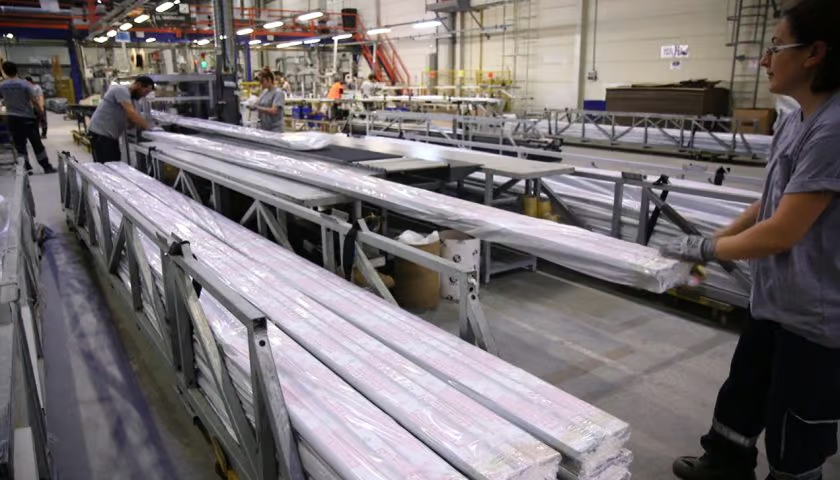
TÜRKİYE – The Climate Investment Funds has approved US$250 million in catalytic funding for Türkiye, expected to mobilise US$2.8 billion in total investment targeting industrial decarbonisation, with recycling and circular economy measures positioned at the centre of the programme.
The inclusion of circular economy initiatives places material recovery and recycling within Türkiye’s industrial emissions strategy.
Secondary production of metals, plastics and paper consumes substantially less energy than primary processing, making recycled feedstock a practical lever for reducing industrial carbon intensity.
The investment plan is projected to reduce or avoid 39 million tonnes of carbon dioxide equivalent annually by 2035, supporting Türkiye’s longer-term goal of reaching net-zero emissions by 2053.
Funding Split Between Development Banks and Private Investors
Of the total, US$1.93 billion is expected from the Climate Investment Funds’ multilateral development bank partners, with a further US$870 million anticipated from private investors and other sources.
The programme will target difficult areas of industrial decarbonisation including green hydrogen, carbon capture, utilisation and storage, energy efficiency and recycling initiatives.
Funding will also support renewable electricity deployment, climate technologies and the development of green markets.
Ministries Developed Plan Aligned With Climate Law
The Ministry of Treasury and Finance and Ministry of Industry and Technology developed the plan.
It aligns with Türkiye’s 2025 Climate Law and the country’s pilot national Emissions Trading System.
Implementation will run through multilateral development bank partners and the Türkiye Industrial Decarbonization Investment Platform, known as TIDIP.
The platform has a broader target of mobilising up to approximately US$5.77 billion for industrial decarbonisation by 2030.
Concessional Capital Absorbs Early-Stage Technology Risk
The Climate Investment Funds expects its anchor capital to mobilise more than US$11 in investment for every dollar deployed under the plan.
The Asian Development Bank, European Bank for Reconstruction and Development and World Bank Group, including the International Finance Corporation, will deliver funding through the platform.
The structure pairs concessional finance with development bank balance sheets, technical expertise and private capital, addressing a persistent financing challenge where recycling infrastructure, green hydrogen and carbon capture require substantial upfront capital and carry risks difficult to price commercially.
The initiative includes a 50 to 100 percent private-sector financing carve-out at project level, with Brazil, Mexico and Türkiye each securing US$250 million endorsements.
An estimated 378 businesses could gain improved access to green finance by 2035, with emphasis on small and medium-sized enterprises and women-led businesses.
Subscribe to our email newsletters that provide busy executives like you with the latest news insights and trends from Africa and the World. SUBSCRIBE HERE
Be the first to leave a comment