

Indian pulp and paper industry accelerates resource optimisation to drive sustainable growth
Industry leaders highlight water efficiency, digitalisation and circular manufacturing as key drivers of competitiveness at the 11th Pulp & Paper Summit.
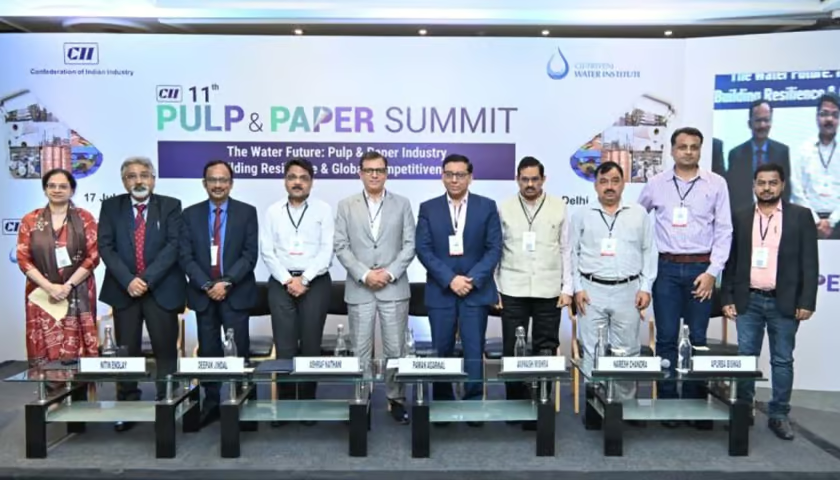
INDIA – India’s pulp and paper industry is accelerating investments in resource-efficient technologies, digital manufacturing and circular production systems as manufacturers seek to improve productivity while reducing environmental impact, according to discussions at the 11th Pulp & Paper Summit organized by the CII–Triveni Water Institute.
The summit brought together paper manufacturers, technology providers, policymakers and sustainability experts to examine how the industry can translate sustainability commitments into measurable operational and business outcomes.
A key technical session, “Action to Impact – Driving Productivity and Resource Optimisation in the Indian Pulp & Paper Industry,” highlighted how leading mills are integrating water conservation, energy efficiency, automation and circular resource management into their manufacturing operations to enhance competitiveness.
Industry participants agreed that sustainability has evolved beyond regulatory compliance to become a strategic business priority capable of lowering operating costs, improving productivity and strengthening long-term resilience.
Water stewardship emerged as one of the event’s central themes, with experts showcasing technologies that enable mills to significantly reduce freshwater consumption while maintaining production efficiency.
Case studies demonstrated the successful deployment of high-efficiency showers, advanced filtration systems, reverse osmosis recovery plants and closed-loop water recycling systems.
Speakers noted that continuous water audits, real-time monitoring and process optimization are becoming essential practices as manufacturers respond to increasing pressure on freshwater resources.
The summit also highlighted growing adoption of waste-to-energy technologies, including biomethanation and compressed methane systems that convert industrial waste streams into renewable energy.
Rather than treating effluent solely as a disposal challenge, several mills are recovering biogas for process heating and power generation, reducing dependence on fossil fuels while improving resource efficiency.
Digitalisation was identified as another key enabler of sustainable manufacturing. Presentations demonstrated how artificial intelligence, intelligent process controls, equipment modernization and automation are helping mills improve fibre utilisation, machine efficiency, product quality and operational reliability.
Industry experts also emphasized the growing importance of circular resource management, where water, fibre, chemicals and energy are continuously recovered, reused and optimized throughout the production cycle.
Participants agreed that maximizing resource value while minimizing waste will be critical to the sector’s future competitiveness.
The session featured presentations from industry leaders including Ashraf Nathani of Mehali Papers Pvt. Ltd., Naresh Chandra of Century Pulp & Paper, Deepak Jindal of Naini Papers Limited, representatives from Emami Paper Mills, Dr. Nitin Endlay of the Central Pulp & Paper Research Institute and Ved Krishna of Pakka Limited, who shared practical examples of sustainability initiatives delivering measurable operational improvements.
The discussions reflected broader trends across the global pulp and paper industry, where manufacturers are increasingly investing in automation, renewable energy, water conservation and circular production systems to meet tightening environmental regulations and customer demand for sustainably produced paper products.
As international markets continue to prioritize low-impact manufacturing, resource optimization is expected to become a defining competitive advantage for paper producers worldwide.
Subscribe to our email newsletters that provide busy executives like you with the latest news insights and trends from Africa and the World. SUBSCRIBE HERE
Be the first to leave a comment