

RIT new starch coating boosts paper packaging recycling, printability
The starch-based coating makes paper packaging recyclable or compostable while retaining protection, cutting plastic waste and advancing circular economy goals.
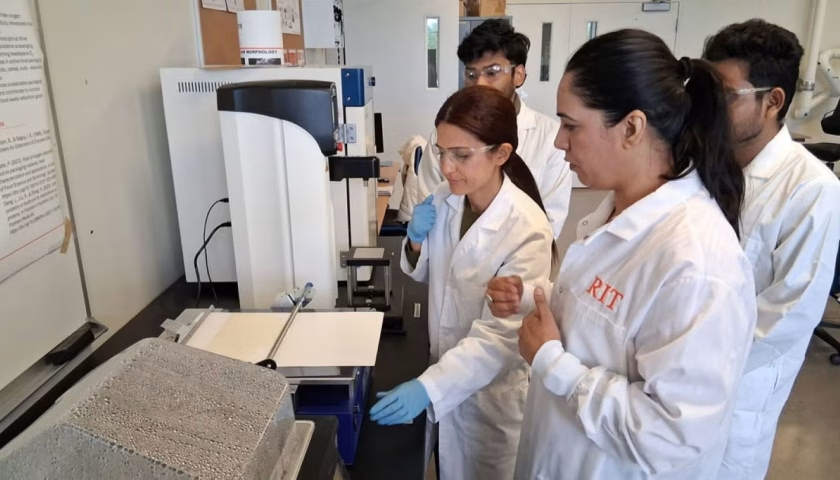
USA – RIT researchers have demonstrated that modified pearl millet starch using crosslinking methods can achieve the same barrier performance as plastic laminations and coatings on paper-based packaging, reducing plastic use while enabling improved recycling and printability for food packaging applications.
The research team led by Sneh Bangar, assistant professor of packaging science at RIT, used crosslinking methods to modify pearl millet starch, altering its internal structure to improve viscosity and stability, enabling it to function as a water-resistant and durable bio-based layer for paper packaging.
Crosslinking bonds polymer materials at the molecular level, a process commonly used to develop alternatives to petroleum-based plastics, with the starch-based coating replicating plastic lamination performance and enabling recyclability.
The coating also supports high-quality printing on paper packaging, maintaining the surface properties required for flexographic and digital printing processes.
Sustainable Alternative for Food Packaging Applications and Recycling
The project addresses the food category, which contributes the most to packaging demand, by adding value to alternative packaging options.
Standard paper-based packaging, such as milk cartons, relies on synthetic laminates to strengthen materials and preserve food, but these laminates make packages difficult to recycle or compost.
Bangar stated, “We were able to achieve the same barriers that plastic lamination or plastic coatings give. The goal is not to eliminate plastics but to reduce the use of the plastics.”
The research was funded by the USDA’s Assisting Specialty Crop Exports, Sustainable Packaging Innovation Lab, in collaboration with Clemson University.
The starch-based barrier supports the growing demand for renewable materials that can reduce reliance on traditional plastics without sacrificing performance.
Recognition and Interdisciplinary Approach
Recent testing results were published in the International Journal of Food Properties, with Bangar receiving the 2026 American Polymers Association Young Scientist Award.
Professor Kyle Dunno, chair of the Department of Packaging and Graphic Media Science, emphasized the interdisciplinary approach, stating that RIT is uniquely positioned to address these challenges through the integration of packaging science, materials research, manufacturing technologies, and product testing.
He added that research like Bangar’s exemplifies how the interdisciplinary approach can transform promising bio-based materials into practical packaging solutions.
The starch-based coating enables paper packaging to be recyclable or compostable while maintaining protective properties, reducing plastic waste and supporting circular economy objectives.
The technology offers a viable path toward reducing plastic consumption in the food packaging sector, where synthetic laminates have historically been difficult to replace due to performance requirements.
Subscribe to our email newsletters that provide busy executives like you with the latest news insights and trends from Africa and the World. SUBSCRIBE HERE

Be the first to leave a comment